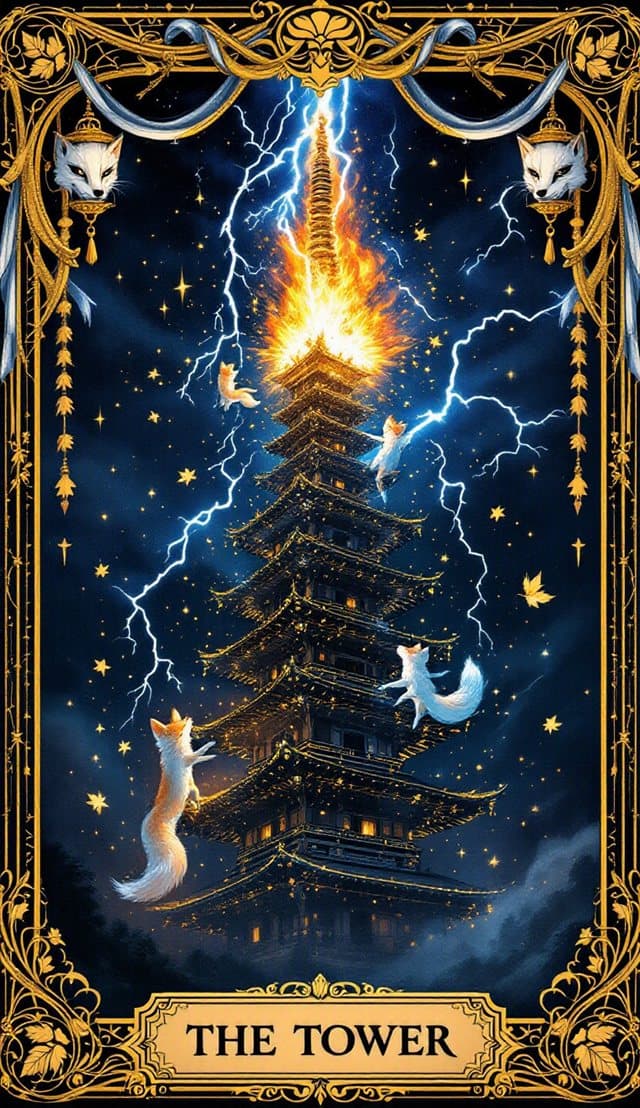
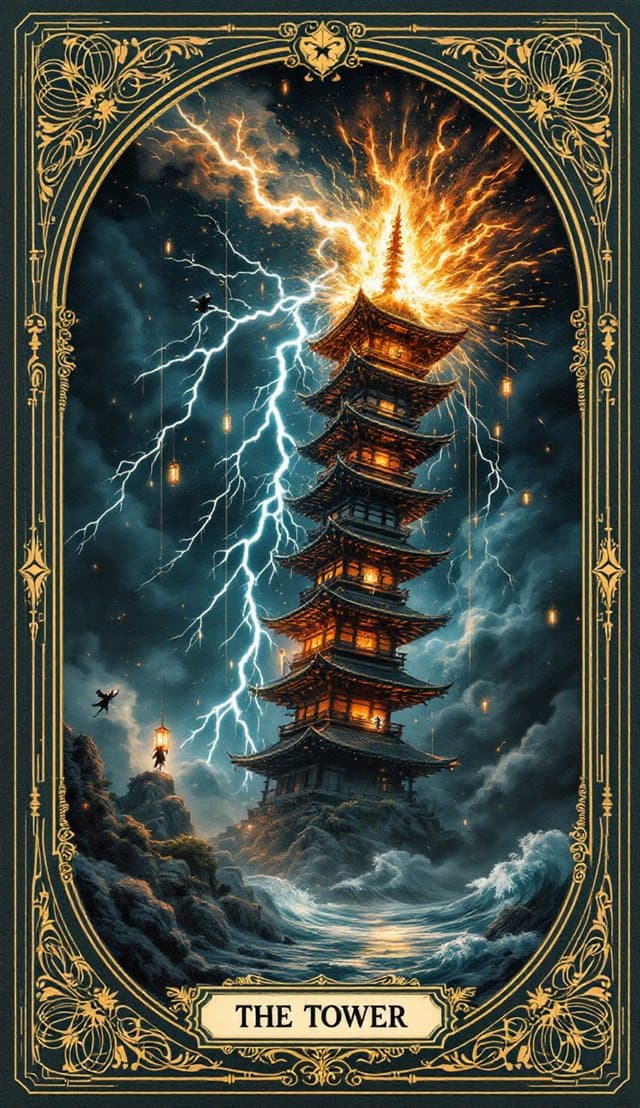
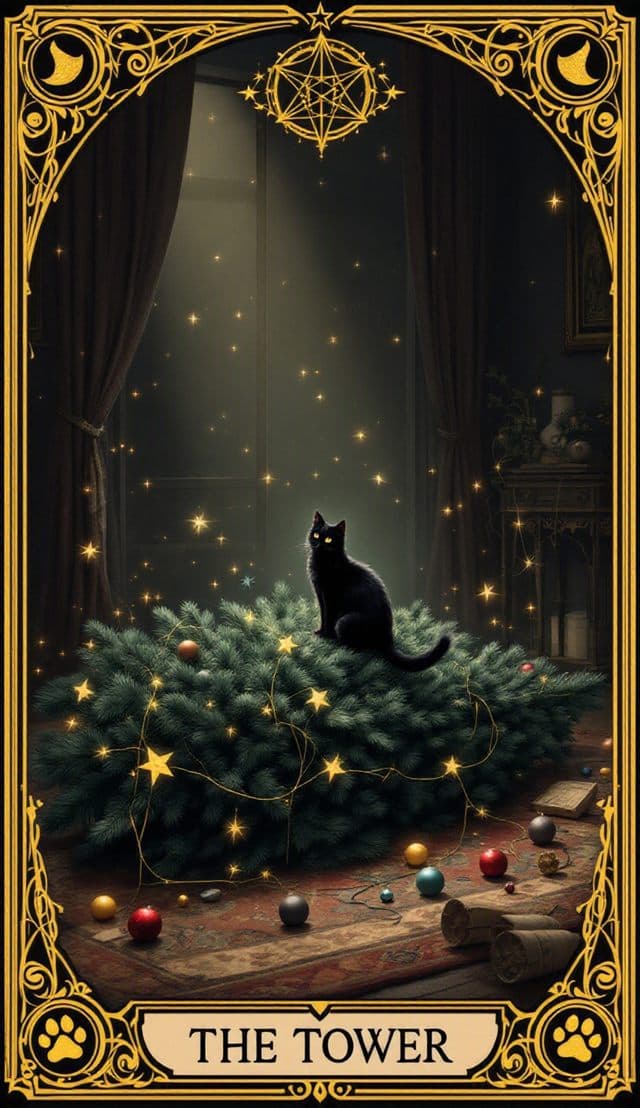
Here is the Tower, three times.
In the Kitsune Tarot, lightning splits the pagoda and the foxes leap. What falls was already hollow, and the strike only proved it.
In the Yōkai Tarot, Raijin's bolt splits the pagoda and what was hollow burns fast. Jump clean, says the card, and then adds the line that makes it a different card: the storm is on schedule.
In Fill the Void, a black cat has caught the Christmas tree mid-topple. Ornaments scatter like meteors. She rides it down with serene amber eyes, entirely at peace with her work, and the reading says: it is coming down, some of that was you, and the truth underneath is worth the mess.
Read those three again and notice what moved. It is not the meaning. All three say the same thing about hollow structures and the mercy of a fast collapse. What moved is the lightning.
Who is holding the match
In two of those decks the Tower happens to you. A god throws a bolt, or the weather does, and your job is to be somewhere else when the roof goes. In the third one you are the lightning. The cat is not a bystander to the collapse. She is on the tree.
That is a genuinely different card to draw on a Tuesday. One version is about surviving something; the other is about having caused something and being strangely fine about it. Same position in the sequence, same core idea, opposite relationship to your own agency in it.
This is what people mean, or should mean, when they say a deck has a voice. It is not the palette.
Three ways to step off a cliff
The Fool makes the same point more gently.
The Kitsune Fool is a kit stepping off the cliff-edge with a paper charm and no plan, and the clouds hold. There is nerve in it, and a little fear, and the charm in its paw is a small hedge against the drop.
The Yōkai Fool is a tanuki with a leaf on its head and a promissory note for luggage. It has no plan and has never once needed one. The card is not nervous. It is comic, and its confidence is the joke and also the advice.
The Void Fool steps off the kitchen counter into a starry hole in the floor, sock toy clutched, utterly certain. The drop is real and so is the certainty.
Three leaps. One is brave, one is absurd, one is domestic and completely unbothered. If you are trying to decide whether to do the frightening thing, it matters quite a lot which of those three is describing you.
The scale test
The Star is where I stopped thinking of the third deck as the novelty one.
In the Kitsune deck a luminous fox pours water back to land and water under one great star. In the Yōkai deck Amabie rises from calm water and pours light on the shore, a healer who asks only to be seen and shared. Both are enormous. Both are the kind of image the card has carried for centuries.
The Void Star is a cat on a windowsill at night, under one eight-pointed star, dipping a paw into a moonlit glass of water.
A glass of water. The cosmic pool has become something on a windowsill, and the card still works: quiet, unhurried hope, the worst has passed, let yourself believe it. An idea that survives being shrunk to the size of a drinking glass is an idea that was actually there. One that only works at cathedral scale was probably just scenery.
Underneath, one deck
For all that, the three are structurally identical, and deliberately so.
Seventy-eight cards each, the same twenty-two majors in the same order, the same four suits wearing different names. Foxfire, Lanterns and Zoomies are one suit: fire, in three costumes. Sake Cups, Mirrors and Saucers are another. There are twelve suit names across the three decks and four elements between them, which is also why the site can compute a yes or no verdict that works the same way in all three.
Even the courts rhyme without matching. The Kitsune deck has a kit where a traditional deck has a page; the Yōkai deck keeps the page; Fill the Void has a kitten, and its knight is a tom. A court card is a person, and each deck has its own idea of what a person is.
What changes when you actually draw
This is not decoration, in the sense that the choice does not stop at the picture.
An interpretation on this site is written from the deck's own words. The reading is handed that deck's name and that deck's text for every card drawn, keywords included, with an instruction to let its imagery colour the language throughout. So a Tower drawn in the Yōkai deck reaches the interpretation as Raijin's bolt and a storm on schedule, and the same Tower in Fill the Void arrives as a cat and a tree and the phrase "some of that was you". The reading you get back is different because the material it is reasoning from is different.
Which means the honest way to choose is not by which art you like most. It is to go and read the same card in all three decks, and pick the one whose version of the Tower you would rather be told about at the worst possible moment.
Some people need to hear that the storm was on schedule. Some people need to hear that they were on the tree.