

Two people draw the same three cards on the same afternoon.
The first asked whether he is coming back. She gets a yes that is not really a yes, spends a fortnight reading the Two of Cups as a promise, and is no further forward in either direction. The second asked what she is not seeing about how it ended. She gets three cards about her own account of the story and has an uncomfortable, genuinely useful evening.
Identical cards. The difference was in the sentence.
What a spread can actually take
A spread is a set of positions, and a position is a question with a shape. The yes or no spread has three: the answer, what tips it, and what to watch. Feed that a question with no binary in it and the machinery still runs, but it is answering something you did not ask.
So the first thing worth knowing is which of your questions is which. "Should I take the job" looks like a yes or no question and is not one. It is a decision, and it is yours. What the cards can speak to is what the job would ask of you, what you are hoping it will fix, and what the version of you who takes it is walking away from. Three positions, none of them yes.
The four questions that do not work
Questions that outsource the decision. Should I, do I have to, is it worth it. These hand the responsibility to a piece of card and take it back the moment the answer is inconvenient, which is how people end up drawing four times about the same job. The rewrite is nearly always to ask about the terrain rather than the verdict: not "should I move" but "what am I actually moving away from".
Questions about the inside of another person. Does she love me. Is he lying. The cards have no access to another human being's interior and neither do you, and a spread that pretends otherwise is just producing a story with someone else's name on it. What you can ask about is the space between you, which is what the relationship spread is for: the two of you, the bridge, what feeds it and what strains it. Three of its five positions are about the connection rather than either person in it.
Questions with no horizon. Will I ever. Am I always going to. There is no card that means "yes, eventually, in about nine years", so an unbounded question comes back as an unbounded answer, which reads as profound and tells you nothing. Put a fence round it. What is in the way of this, this autumn.
Questions you have already answered. You know the ones. If you catch yourself hoping for a particular card, you are not asking, you are looking for permission. That is worth noticing rather than suppressing. Sometimes the honest question underneath is "what would it cost me to admit I have decided", which the cards can absolutely work with.
The rewrite
Here is the whole technique, and it takes one line.
Write the question down before you shuffle. If it will not fit in a single sentence, you are asking two things and the reading will answer whichever one the first card happens to fit. If it starts with "will" or "should", try starting it with "what" or "how" instead and see whether the new version is more interesting. It usually is.
"Will he come back" becomes "what am I not seeing about how this ended". "Should I take the job" becomes "what am I hoping this job will fix". "Does she love me" becomes "what is this actually built on". None of these are softer than the originals. They are harder, which is the point: the first version could be answered by a coin, and the second one could not.
Fitting the question to the layout
Once the question is right, pick the shape that matches it.
A question with a history and a direction wants past, present and future, which is an arc and reads badly when you feed it something static. A question about a situation you are stuck inside wants the Celtic Cross, which has ten positions precisely because "why is this like this" has more than three parts. A genuine binary, the rare kind where both outcomes are real and you would act differently under each, wants the three-card yes or no.
And if none of them fit, build one. Write your own positions, and write them as questions rather than nouns. "What I am avoiding" is a position that can be answered. "Career" is a filing cabinet, and a card dropped into it will mean whatever you were already thinking.
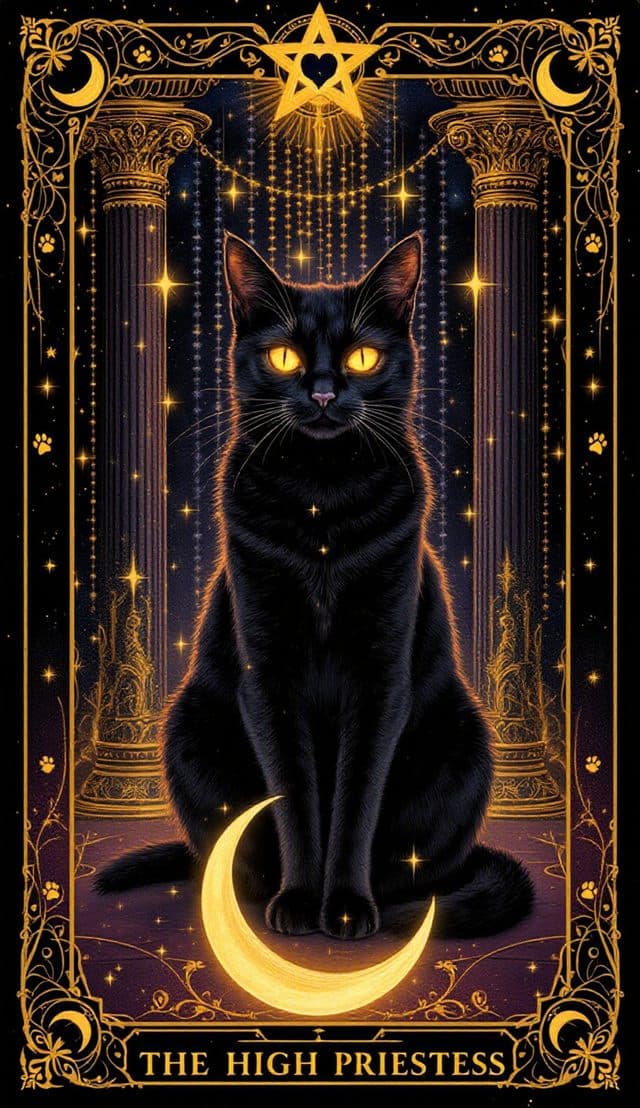
Why the High Priestess is at the top of this page
Because she is the card of the thing not yet spoken, and in a yes or no reading she is one of the majors that refuse to give a verdict at all. That is not the deck being evasive. Some questions have not finished forming, and a reading that returns "not yet, and you know why" is more use than a confident answer to a question you had not properly asked.
Write the sentence down first. Everything after it is easier.