There is a moment, when Death turns up in a spread, where the person opposite you stops breathing for a second. Every reader knows it. It happens even with people who have just spent ten minutes telling you they do not believe in any of this.
The card has a reputation entirely out of proportion to what it says, and the gap is largely the fault of film.
What the card is actually about
Death is XIII, the thirteenth of the twenty-two major arcana, and it sits at a very deliberate point in the sequence. It comes after the Hanged Man, which is suspension, and before Temperance, which is the slow work of mixing something new. It is the hinge between them.
What it describes is a threshold. Something has ended, genuinely and not negotiably, and the work now is to walk through rather than stand in the doorway arguing. The traditional reading is not something will end. It is something already has, and you are still holding the handle.
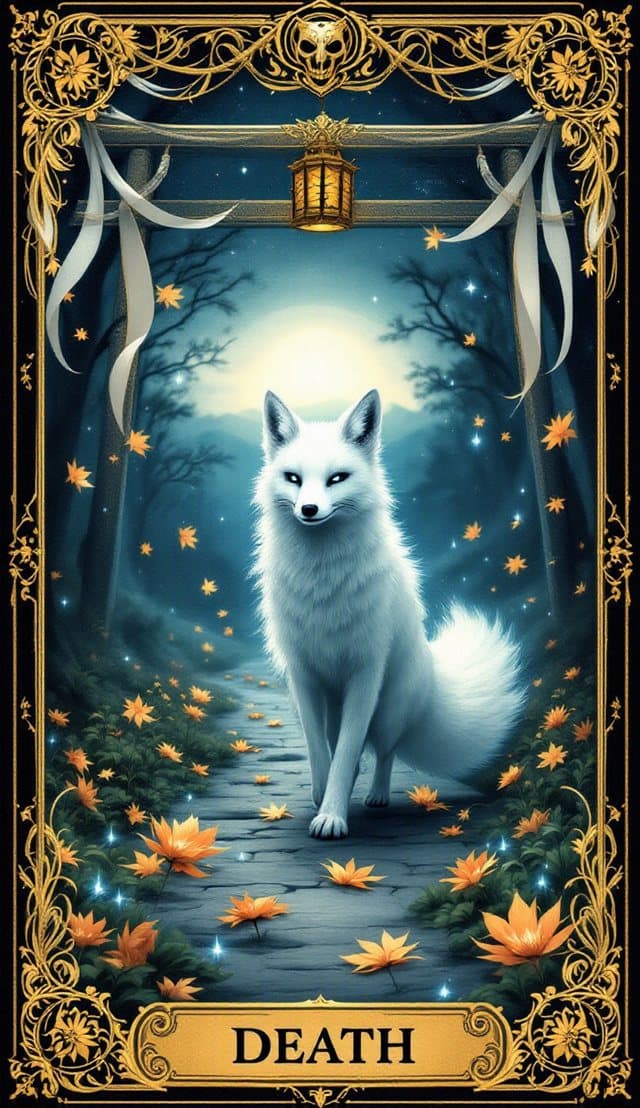
That is why the reversed reading is the harder one. Upright, the ending is happening and you are moving. Reversed, in the Kitsune deck's words, it is "a season dead on the branch, refusing to fall". The card's difficult face is not death. It is refusing one.
Three decks, three thresholds
All three decks here paint the same idea and none of them paints a corpse, which is not squeamishness. It is that a corpse would be a mistranslation.
In the Kitsune Tarot a masked white fox walks the lantern road, leaves falling behind it and shoots rising where it steps. The ending and the growth occupy the same picture, a few feet apart.
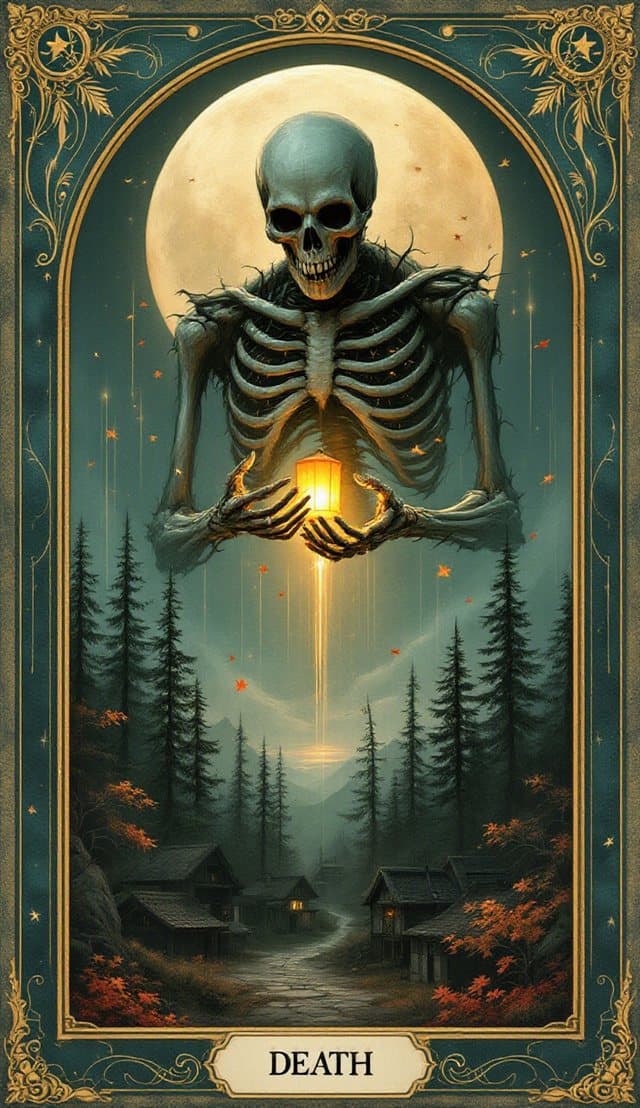
In the Yōkai Tarot a gashadokuro, a giant skeleton made of the unburied, could crush the village below it. Instead it cradles one small lantern, and the rooftops sprout green. The enormous frightening thing turns out to be carrying the light.
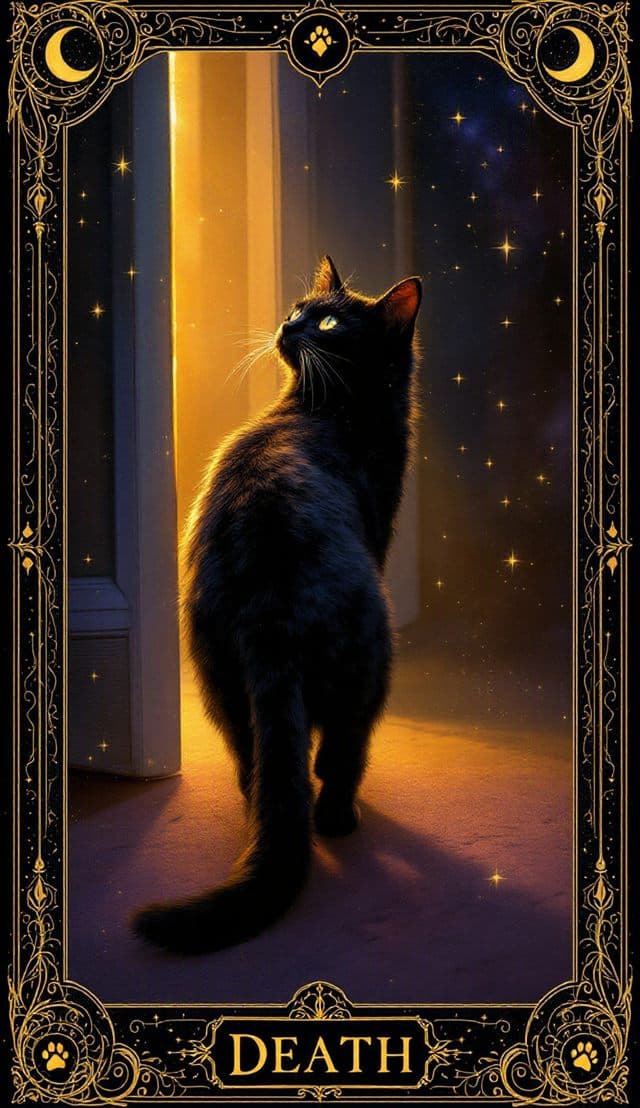
In Fill the Void a cat walks out through a door left ajar, away from a dim room of outgrown toys, dawn on her whiskers, not once looking back. Its reversed reading is the one that stings: standing in the doorway holding an outgrown toy, negotiating with an ending that has already happened.
Three paintings, three centuries of iconography, one idea. Nobody is dying in any of them.
The card to actually watch is the Tower
Here is the part that surprises people.
If you want the card that describes something sudden, unasked for and genuinely destructive, it is not Death. It is XVI, the Tower: lightning splitting the pagoda, the structure coming down, everyone leaping clear. Death is a threshold you can see. The Tower is a Tuesday afternoon that rearranges your year.
And even the Tower is kinder than it looks, because what it takes down was hollow already. The strike does not make the building rotten. It reveals that it was.
Death gets the reputation because of the name. The Tower does the work.
So what if it does turn up
Read it as the deck reads it. Something is over. Grieve it properly, and then go.
Which position it lands in matters more than the fact of it. In the past position it is an ending you have already survived and are still carrying. In the outcome position of a Celtic Cross it is the reading telling you the current arrangement does not continue, which, depending on the question, is frequently the best news in the spread.
And if you would rather not have the conversation at all, every spread on this site lets you turn reversals off before you draw, and every card's meaning is readable in full without drawing anything. Browse the majors and look at XIII in daylight, with nothing riding on it. It is a much less dramatic card when nobody is holding their breath.